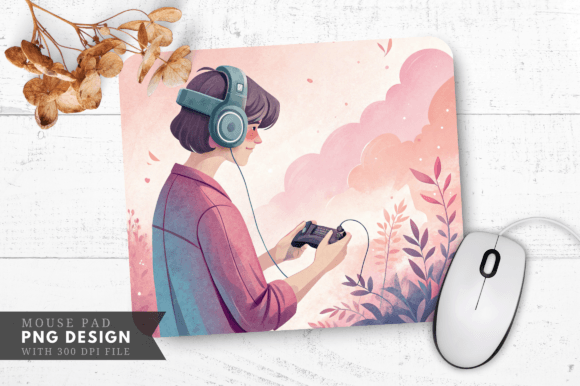
Gaming in VR with Style Mouse Pad PNG
From Pixels to Play: Why Your Setup Deserves Visual Cohesion
Walk into any dedicated gaming space and the first thing you notice isn't the PC specs or the headset model—it's the atmosphere. A cohesive visual environment transforms a desk into a command center. Virtual reality amplifies this because the boundary between physical and digital disappears the moment you put on a headset. When you lift the visor for a water break or to check a notification, the objects around you should reinforce that immersive mindset. A Gaming in VR with Style Mouse Pad PNG file gives you the raw material to bridge those two worlds, letting your desk surface echo the energy of the virtual arenas you inhabit.
The file itself is straightforward. You receive a single PNG, 300 DPI, measuring 3480 by 2460 pixels, delivered with a transparent background. No watermarks, no locked layers. What you do with those dimensions depends entirely on your imagination and the production tools available. This isn't a finished product wrapped in cellophane. It's a high-resolution digital asset built for customization, which immediately appeals to a broad audience: streamers who want branded scenery, VR enthusiasts tired of generic gear, small business owners running print-on-demand shops, educators setting up simulation labs, and crafters who live inside Cricut Design Space.
Understanding the difference between a standard web graphic and a print-ready PNG matters here. Most images downloaded from social platforms sit at 72 DPI and disintegrate when stretched beyond a thumbnail. At 300 DPI, you can scale this design across an extended mouse pad without jagged edges or blurring. The transparent file also means you aren't locked into a specific background color. You can layer it over a neon gradient, a carbon fiber texture, or solid black before sending it to production.
The Resolution Equation: What 3480x2460 Pixels Really Means
Pixel dimensions tell the story of physical size. A 3480-pixel width at 300 dots per inch yields roughly 11.6 inches across. That's larger than a standard mouse pad, which typically ranges between 9 and 11 inches wide for medium desk mats. The extra resolution acts as a safety margin—you can crop, rotate, or reposition the artwork without sacrificing clarity. For extended pads that span 31 inches, drop the DPI requirement to 150, and the file still holds up because viewing distance reduces the need for extreme density. Print providers often request 150 to 300 DPI at final output size, and this PNG comfortably meets both thresholds.
This matters especially for sublimation printing, the most common method for full-coverage mouse pads. Sublimation infuses dye directly into polyester fabric or coated neoprene, so the image becomes part of the material rather than sitting on top like a vinyl decal. The process demands crisp edges and consistent color fields. Low-resolution files produce soft, muddy results that cheapen the final product. Using a properly sized PNG eliminates that variable, which is why crafters and small-batch manufacturers gravitate toward assets delivered at production-ready specs.
Customization Without Compromise: Building a VR-Themed Battle Station
VR gamers face a unique design challenge. Their peripherals aren't just a keyboard and mouse—they include headset stands, controller charging docks, cable management systems, and often a cleared play area. The mouse pad becomes the visual anchor, the largest uninterrupted surface on the desk. Choosing or creating a design that references VR iconography ties the entire station together. Think geometric wireframe motifs reminiscent of VR loading environments, low-poly landscapes that mirror popular virtual worlds, or abstract representations of motion tracking grids.
- Headset Storage Integration: A matching print on the pad and a custom vinyl decal on the headset stand creates intentionality.
- Streaming Backdrop Sync: Extract colors from the mouse pad design for your overlay borders and alert animations.
- Cable Sleeve Coordination: Print the design on heat-transfer vinyl to wrap visible cables, making the entire desk feel manufactured as a set.
- Controller Skin Mockups: Use the same graphical elements to cut skins for VR controllers, reinforcing brand or aesthetic unity.
The transparent file is a powerful tool in this scenario. You can place the Gaming in VR with Style Mouse Pad PNG onto any background mockup to preview how the final product will look against different desk setups. This drastically reduces costly print mistakes. Design editing software that supports PNG layers—Affinity Designer, Adobe Photoshop, GIMP, or even Canva's premium tier—handles the workflow without friction. Unzip the file, import it, set your canvas dimensions to match the production template from your printer, and drag the artwork into position.
The Maker Economy and Personalized Peripherals
Beyond personal use, there is a growing market for customized gaming accessories. Etsy shop owners, Shopify storefronts, and local print shops all compete on speed and uniqueness. Stock images from public domain libraries perpetuate sameness. When a seller sources or creates a specialized VR-centric graphic, they immediately differentiate their mouse pad listings from the sea of generic galaxy prints and anime collages.
Business owners should note the licensing flexibility implied by assets distributed in this format. Because the file arrives without watermarks and can be used across multiple products—bags, mugs, tumblers, cutting boards, signs, phone cases—the return on investment spreads thin across an entire product line. A single design can anchor a cohesive catalog. Someone who discovers a seller through a VR mouse pad might return for a matching phone case or tumbler, accelerating customer lifetime value. The transparent also allows for quick colorway variations. Shift the hue, adjust saturation, or add a glow effect to create "limited edition" drops without commissioning new artwork.
Navigating Color Variation Between Screen and Substrate
Every monitor displays color differently. A vivid cobalt blue on an OLED gaming monitor can print as a muted navy on uncoated neoprene. This isn't a flaw in the file; it's the physics of light versus pigment. RGB displays emit light, while printed surfaces absorb and reflect it. Additionally, different print methods—sublimation, UV printing, screen printing—yield different color gamuts. Sublimation on polyester typically produces bright, punchy results but struggles with exact Pantone matching. UV printing on hard surfaces like cutting boards delivers sharper detail but can appear slightly darker due to ink density.
Users can mitigate these shifts by requesting a proof from their print provider or by printing a small test swatch before committing to full production. Adjusting brightness and contrast upward by 10-15% in editing software often compensates for the natural darkening that occurs during sublimation. Keeping the original PNG unaltered as an archive ensures you always have a master file to revert to. The note that "actual colors may vary slightly due to monitor settings" isn't a disclaimer to fear—it's a heads-up to plan for. Experienced makers embrace this as part of the craft.
Expanding the Canvas: Alternative Products That Benefit
While the mouse pad is a natural starting point, the 3480x2460 pixel resolution opens doors to larger items. Cutting boards measuring 11x8 inches or even 15x11 inches sit well within this file's usable range at 300 DPI. Sublimatable tumblers, skinny straight or tapered, require tall narrow templates that you can crop from the wider canvas. Phone cases, depending on the model, demand even less real estate, so the design won't compromise quality. Stickers printed through a Roland or Silhouette cutter benefit from the transparent to create kiss-cut or die-cut shapes with no white border unless intentionally added.
- Signage: Print on aluminum composite panels for a durable, lightweight VR room sign.
- Tote Bags: Full-bleed sublimation tote bags transform the graphic into wearable art.
- Journals and Notebooks: Hard cover sublimation creates a professional-looking planner for game designers.
- Wall Art: Frame the print on canvas for a game room focal point.
Each application requires a slightly different workflow, but the source asset remains constant. This single-file approach reduces asset management complexity. Creators store one master PNG and export derivatives tailored to specific product templates. The transparent background makes compositing seamless, whether you're laying the design over a wood grain texture for a cutting board mockup or onto a curved surface for a mug preview.
Unzipping and Software Readiness: The Technical Baseline
The delivery mechanism—a zip file—keeps the download size manageable and prevents browser-based compression artifacts. Upon purchase, the buyer receives a compressed folder containing the single PNG. Unzipping requires a computer; mobile devices often struggle with large high-resolution files and may downsample them before the user even accesses the data. Once extracted, any design program that opens PNG files works. Free options include GIMP, Inkscape (for vector-like compositing via imported raster), Photopea, and Paint.NET. Paid ecosystems like the Adobe suite or CorelDRAW offer more powerful color management and soft-proofing tools.
File organization habits matter. Rename the extracted PNG descriptively: "VR_Style_Mousepad_300dpi_3480x2460.png." Back it up to cloud storage and a local external drive. If you plan to sell products using this design, maintain a changelog of alterations so you can replicate or revise versions without starting from scratch. Version control might feel like overkill for a single image, but six months later when a customer asks for a slightly altered repeat order, you'll recover that work instantly.
Design Principles That Elevate a VR-Themed Surface
Good mouse pad design balances visual impact with practical use. Optical and laser sensors track on any printed surface, but extremely busy patterns with high-contrast micro-details can theoretically confuse older sensor models. Modern gaming mice handle this reliably, so the design constraint is less about sensor compatibility and more about user experience. Text and UI elements placed under the mousing zone become unreadable, so critical typography should sit in the periphery—corners, top strip, or far edges—where the hand rarely travels.
VR-themed graphics often lean into the illusion of depth. A shattered grid effect receding toward a central focal point complements the way VR environments render. Neon color palettes (cyan, magenta, electric blue) pop against black neoprene and sync with the RGB lighting most gaming setups feature. The transparent file comes with no locked background, so users can build their own dark canvas and position the graphic to avoid wear zones. Edges receive the most friction and fade first on stitched-border pads, so placing the most intricate design elements near the center preserves them longer.
Practical Considerations for Long-Term Durability
Even the most stunning print eventually faces friction, wrist pressure, drinks, and direct sunlight. Sublimated polyester tops with rubber non-slip bases resist fading for years under normal use. Washing with a damp cloth and mild soap maintains brightness. Do not machine wash sewn-edge pads—stitching may unravel, and the rubber base degrades in hot water. Hard goods like cutting boards require hand washing to preserve the print layer. UV printing on ceramic mugs and aluminum signs handles dishwashers and outdoor exposure better than sublimation, but always check manufacturer guidelines for your specific production method.
If you plan to sell products made from this design, consider including a small care card with each order. The gesture builds trust and reduces returns due to mishandling. Information about color variation across monitors also sets appropriate expectations, especially for buyers comparing the physical product to a highly saturated Etsy listing photo viewed on a bright phone screen.
Who Gains the Most From This Type of Asset
The audience for a high-resolution gaming mouse pad PNG spans wider than one might assume. Competitive VR esports players use custom pads to reinforce team identity during LAN events. Educational VR labs in universities and hospitals benefit from branded surfaces that indicate designated play boundaries. Content creators filming hands-on VR reviews value a distinctive desk backdrop that supports their visual brand without requiring constant set redesign. Casual hobbyists who own a Cricut Maker use the same file to cut iron-on for a sweatshirt, a decal for their water bottle, and a stencil for etching glassware—all from a single download.
Each group accesses the file with different goals, but they converge on the same need: high resolution, transparent, unwatermarked, and ready to slot into existing production pipelines. The mention that different monitors display color differently reminds everyone to soft-proof or test print, a step that separates amateur crafters from professional output. Regulrcrative—the intended closing note—signals a polite, professional origin, reassuring buyers that the transaction concludes with a genuine, usable file rather than a compressed preview.
A Deeper Look at the Virtual and Physical Overlap
VR as a medium thrives on presence—the feeling of being somewhere else. When a gamer sets down their controller, removes the headset, and looks at a mouse pad that visually extends the virtual environment, the transition between realms feels smoother. It's a detail that seems minor until experienced. The brain appreciates continuity. This is why set designers in film obsess over props that characters hold right after a CGI sequence; any jarring shift breaks the spell.
Using a Gaming in VR with Style Mouse Pad PNG to produce that object means you control every aspect of the illusion. You select the color palette, the background contrast, the final dimensions. You aren't limited by a manufacturer's pre-printed catalog. That agency reflects a broader trend in gaming culture toward personalization. RGB lighting, custom keycaps, 3D-printed headset mounts—all movements toward the individual. This file plugs straight into that ethos.
Workflow Recap and Creative Freedom
Start by unzipping the file on a computer. Open it in your preferred design software. Define your target product dimensions, and either set the PNG as the sole layer or composite it atop a complementary background. Export a production-ready file in the format your printer or cutting machine requires—usually a high-quality JPEG or PNG, occasionally a PDF for wide-format printing. Run a small test if batch producing. Then scale confidently, knowing the source asset won't degrade.
The creative possibilities multiply once you treat the design not as a static image but as a modular element. Isolate a section for a phone case, mirror it for symmetry on a tote bag, apply a duotone filter for a different product line. The transparent file accommodates all of this. No watermarks on the final item means the end product looks purely yours—no intrusive branding, no leftover artifacts from the download process.
As virtual reality continues its steady integration into mainstream gaming, the demand for peripherals that reflect that culture will grow. A well-designed mouse pad serves as the desktop centerpiece. This PNG provides the starting point. The rest belongs to your printer, your heat press, your laser engraver, and your imagination. The file is what you make it.